
Carson County Parole and Probation
Parole follows a Texas prison sentence and permits a person to serve part of that sentence in the community under TDCJ Parole Division rules. Mandatory supervision is another TDCJ release category created by statute, but eligibility and Board review depend on the offense and its date. Probation, called community supervision in Texas law and court records, is imposed by a court instead of, or following a suspended portion of, confinement. A person can be out of a jail building yet remain subject to one of these legal forms of supervision.
| Record | Parole or mandatory supervision | Probation or community supervision |
|---|---|---|
| Source of authority | TDCJ Parole Division and BPP action | Sentencing court and community-supervision order |
| Best person-specific starting point | Current TDCJ detail, parole status telephone channel, then Amarillo DPO | Carson clerk file and the supervision office named in the judgment or transfer record |
| End of supervision | Discharge recorded through TDCJ records processes | Court or supervision record showing completion, early discharge, revocation, or other disposition |
| Not proof of release | A favorable vote or review date | A docket entry that does not show the signed order |
Verify Carson County Post-Release Supervision
Begin by separating a county-jail case from a TDCJ sentence. The Carson County sheriff can document departure from the county jail, but that local entry does not by itself show the current terms of parole, probation, or another agency hold. Use a TDCJ or SID number when possible because names can match. Compare the offense, conviction county, and court before drawing a conclusion.
- Obtain the release or transfer entry from the Carson County Sheriff, especially when the person was last known at the county jail.
- For a state prisoner, check the TDCJ current-inmate search. Its person detail can show parole-review information while the person remains incarcerated.
- Call the TDCJ pre-vote status line at 844-512-0461 or the favorable-vote release-status line at 512-406-5202 when that stage applies.
- For field supervision in Carson County, confirm the assignment with the Amarillo District Parole Office. Do not substitute a Board or institutional office.
- For probation, request the signed judgment, conditions, modification orders, and final disposition from the Carson combined clerk or the office named in the court record.
- Confirm actual discharge through the record-owning agency. Absence from a current-inmate search is not a discharge certificate.
Note: TDCJ live inmate information updates on working days and is at least 24 hours old, so direct confirmation still matters.
Carson County Releasees Use Amarillo DPO
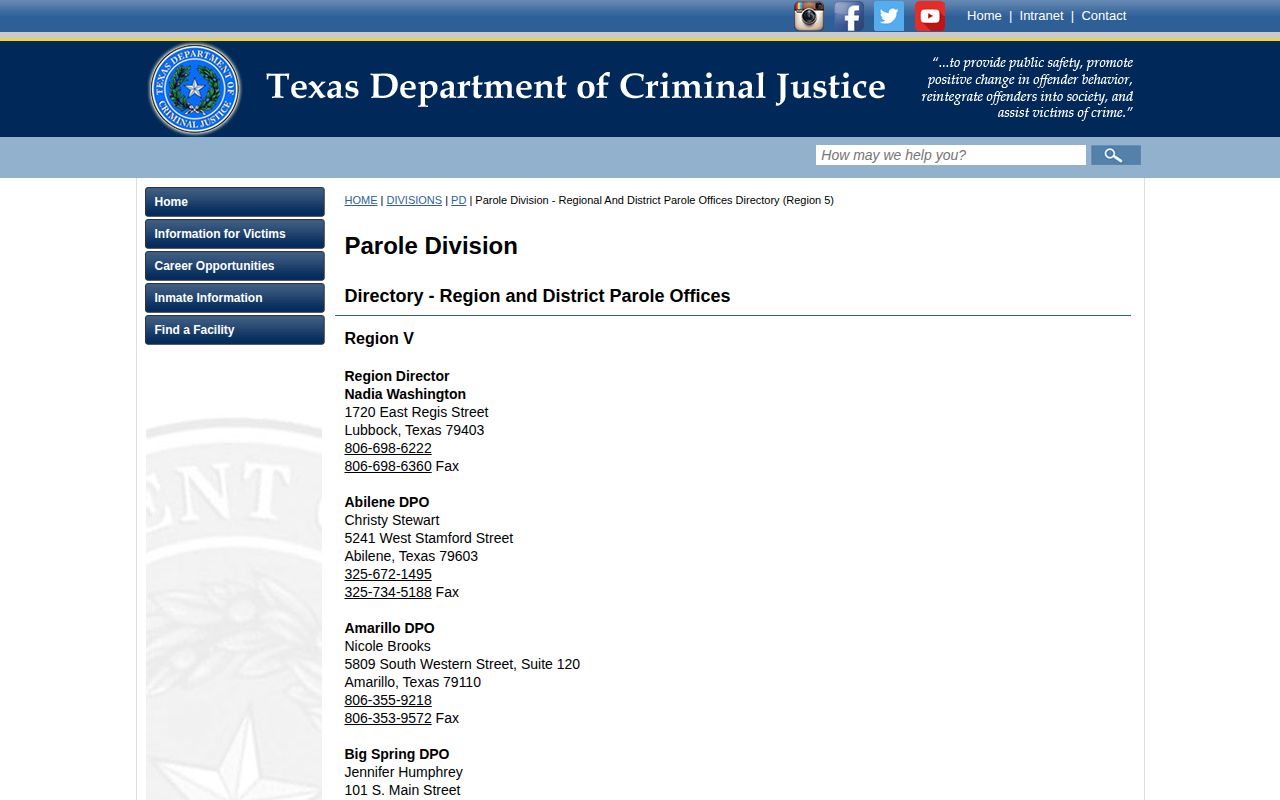
TDCJ's county mapping assigns Carson County parole field supervision to the Amarillo District Parole Office. This is the practical contact for reporting-office questions and field-supervision routing. The published office listing is 5809 South Western Street, Suite 120, Amarillo, TX 79110, telephone 806-355-9218, and fax 806-353-9572. Confirm a person's assignment before visiting because an individual case may be transferred or managed under a different approved arrangement.
Amarillo District Parole Office
5809 South Western Street, Suite 120
Amarillo, TX
79110
806-355-9218
Fax: 806-353-9572
The official Amarillo DPO page is the source for the field-office listing shown below.
The DPO is not the Carson probation records custodian. For a community-supervision case, use the sentencing-court record to identify the responsible department. If supervision moved across state lines, request the transfer or reporting terms rather than assuming the Carson or Amarillo office still manages day-to-day reporting.
Why Three Amarillo Parole Offices Differ
Three Amarillo labels can look interchangeable in search results, but they serve different functions. The Amarillo District Parole Office conducts field supervision. The Amarillo Board Office performs Board voting work. The Institutional Parole Office develops cases inside correctional institutions. A person trying to confirm where a Carson County releasee reports needs the DPO, not an office selected merely because it contains the word “parole.”
A 2025 Seventh Court of Appeals decision involving one Carson probationer described monthly written reporting after an interstate transfer. That is useful evidence that transferred supervision can have tailored reporting methods. It is not a countywide rule. Conditions belong to the individual order and later modifications, so another person's reporting frequency or method must be verified from that case's record.
Note: Office function and case assignment are separate questions; confirm both before sending documents or appearing in person.
Carson County Parole Review Records
Texas parole review is generally an administrative file process, not a public courtroom hearing with a person-by-person calendar. TDCJ identifies an initial file roughly six months before eligibility, and later review work occurs roughly four months before the review date. An institutional parole officer interviews the inmate and prepares a case summary. A three-member panel votes, and two matching votes decide the result.
The BPP meeting schedule is a calendar for public Board business. It expressly is not a calendar of individual offender decisions. For a named current inmate, use the parole-review information at the bottom of the TDCJ detail and the appropriate telephone status channel. Correspondence conveys the decision, and a denial supplies later-review information.
Official vote options include FI-1, release when eligible; FI-2, release in a stated future month and year; several FI program votes; and RMS, release to mandatory supervision. Denial language includes NR, SA, and DMS. These codes describe Board action, not a jail-gate timestamp.
A Carson County Parole Grant Is Not Release
A favorable vote can still be followed by required program work, legal-eligibility checks, detainer review, sentence processing, or new Board action. Scheduled release date and scheduled release location appear only after TDCJ completes later processing. A receiving agency can also take custody immediately, which means departure from TDCJ is not necessarily release into the community.
Government Code §508.145 controls parole eligibility by offense, date, sentence, weapon findings, and special category. Section 508.149(a) lists mandatory-supervision exclusions. Texas does not have a universal rule requiring every inmate to serve 85 percent. Eligibility is not release, and a projected calculation is not a final discharge.
When a vote uses an FI program code, obtain the exact code and later completion record. FI-3R, FI-4R, FI-5, FI-6 or FI-6R, FI-7R, FI-9R, and FI-18R describe different program paths. CU/FI addresses consecutive sentences. New information can also cause an approval to be withdrawn. These distinctions explain why a Carson County family should not schedule around a vote date alone.
Carson County Supervision Changes and Warrants
Conditions may address reporting, travel, programs, residence, fees, testing, or conduct, but the exact terms come from the person's certificate, court order, and amendments. Do not infer a violation from a missed public update. A warrant, summons, modification, revocation, or return to custody requires confirmation from the agency or court that issued it.
Texas IVSS-Counties can provide custody or supervision event notices when available, yet it warns that information may be delayed, incomplete, or inaccurate. It is an alert service, not a warrant database or certified discharge record. For a county-jail return, ask the sheriff for the booking and later release or transfer entry. For a parole matter, contact TDCJ. For probation, obtain the court filing and signed order.
The Carson County Carson County released-inmate search and records guide explains how to pair the sheriff event with court context. That two-record method is especially useful when a supervision event leads to short custody and another transfer.
Confirm Carson County Supervision Discharge
Physical release, the end of reporting, and sentence discharge are not synonyms. TDCJ's Parole Division Central File Coordination Unit updates records to reflect discharge and handles related records work. A person no longer visible in the live TDCJ search may have been released, discharged, transferred outside its current-inmate scope, or omitted for another reason. Historical confirmation therefore comes from TDCJ information channels or a Public Information Act request.
For probation, request the final order or docket disposition from the Carson clerk. The combined clerk and 100th District contact is at 501 Main Street, Panhandle, with telephone 806-537-3873. The county pages discuss e-filing but do not offer a public name-based case search, so direct contact is the documented route. Ask for the exact cause number when known.
Texas expunction and nondisclosure law can limit access to qualifying records. Respect a lawful restriction and avoid treating a missing record as evidence of current supervision. The strongest conclusion comes from a discharge record issued by the proper agency, matched to more than a name.
Public Record Search
Sponsored Results