
Label Every Carson County Release Date
Record language should preserve the agency's own stage. A parole eligibility date marks when review may occur. A projected date is a sentence calculation. A scheduled date reflects later release processing. The actual release date records custody exit, while a discharge date marks the end of a sentence or supervision. These dates can all differ in one Carson County case. Quote the field name, identify its source, and note when it was checked so a later reader does not mistake an old projection for the completed event.
Carson County Date Records Answer Different Questions
The Carson clerk file can supply the judgment, sentence, jail-credit notation, bond or release order, revocation, and later discharge. Those court records explain legal authority, but they may not state the minute physical custody ended when another hold existed. The sheriff's event record answers the physical custody question. Keeping both dates, and labeling what each represents, prevents an order date from being mistaken for a gate departure.
For a formal county request, seek existing release-log entries for a narrow date range and specify release date and time, reason or type, bond information, court reference, and transfer destination. Carson County posts no jail-record fee schedule or calculation worksheet. Ask the custodian about available format and cost. The Public Information Act response framework is not a promise that a release record will be delivered on the date requested.
Carson County Projected and Actual Release Dates
TDCJ defines a projected release date as the date its Classification and Records Office calculates for a current inmate to leave incarceration if parole does not occur sooner. Offense title, offense date, sentence structure, credit, and mandatory-supervision law affect the result. It is not a court judgment, a promise of release, an exact gate time, or proof that the sentence later discharged.
A Carson County Jail detainee awaiting trial has a different record. Release could follow bond, personal bond, a court order, dismissal, transfer, or another event, so no dependable date can be calculated from the booking alone. A sentenced county inmate may have a computed date, but the sheriff and judgment records control. If the person leaves for TDCJ, BOP, USMS, or ICE custody, the Carson event is a transfer even when it looks like departure from the local jail.
How to Run a Carson County Release Date Lookup
Start with the last confirmed custodian, not the nearest facility name. Carson County has no TDCJ unit, BOP institution, or ICE detention center confirmed within the county, but a local case can move into any of those systems. Use a booking, TDCJ, SID, or federal register number when available, and compare the case before relying on a same-name result.
- For the county jail, contact the Carson County Sheriff at 806-537-3511 and ask whether the record shows custody, a planned event, actual release, or transfer.
- Request the judgment, jail-credit order, bond or release order, and later disposition from the Carson clerk when a court event controls the date.
- For a state prisoner, use the TDCJ current-inmate search by exact last name and first initial, TDCJ number, or SID number.
- Read projected release and parole-review information as forecasts. After processing, look for Scheduled Release date and Scheduled Release location.
- If the live result is absent after departure, use TDCJ email, telephone, or Public Information Act channels for historical release or discharge records.
- For federal custody use the BOP locator; for ICE use the Online Detainee Locator. USMS pretrial status requires the federal court docket or USMS records route.
- After the date passes, confirm the actual event and destination with the agency record.
Note: The TDCJ search includes current inmates only, updates on working days, and states that information is at least 24 hours old.
TDCJ Fields for a Carson County Prisoner
The statewide search accepts last name, first name, TDCJ number, SID number, gender, and race. Exact last-name matching applies, and a number is safer when several people share a name. The current detail can show location, offenses, projected release date, parole-review information, and later scheduled-release fields. None of these fields creates a Carson County jail release record.
| Field | How to use it |
|---|---|
| Projected Release Date | A current TDCJ calculation if parole does not happen sooner, subject to the governing sentence law. |
| Parole Review Information | Board-review stage or result when applicable, not proof of physical departure. |
| Scheduled Release date | A later processing date that may still change without notice. |
| Scheduled Release location | The planned TDCJ departure point, not proof of a final community destination. |
| Location and offenses | Identity and custody context that should match the known case. |
Historical TDCJ information can be requested by email without a stated charge, by telephone through 936-295-6371 or 800-535-0283 during published weekday hours, or through the TDCJ Public Information Act form. Ask for the actual release, transfer, parole, or discharge event rather than asking staff to predict a legal outcome.
Texas Release Calculations for Carson County Cases
For mandatory-supervision-eligible offenses committed before September 1, 1996, TDCJ generally projects release when flat time plus good time reaches the sentence total if parole has not occurred. For eligible offenses on or after that date, the credit relationship also requires BPP approval under discretionary mandatory supervision. A denial can move the projected date to maximum expiration, while a later approval can move it forward.
For a person excluded from mandatory supervision, projected release generally follows maximum expiration based on flat time unless parole occurs first. Government Code §508.149(a) identifies exclusions. Consecutive sentences, offense-date law, specialized categories, and Board action can change the path. A single online date should never be separated from those facts.
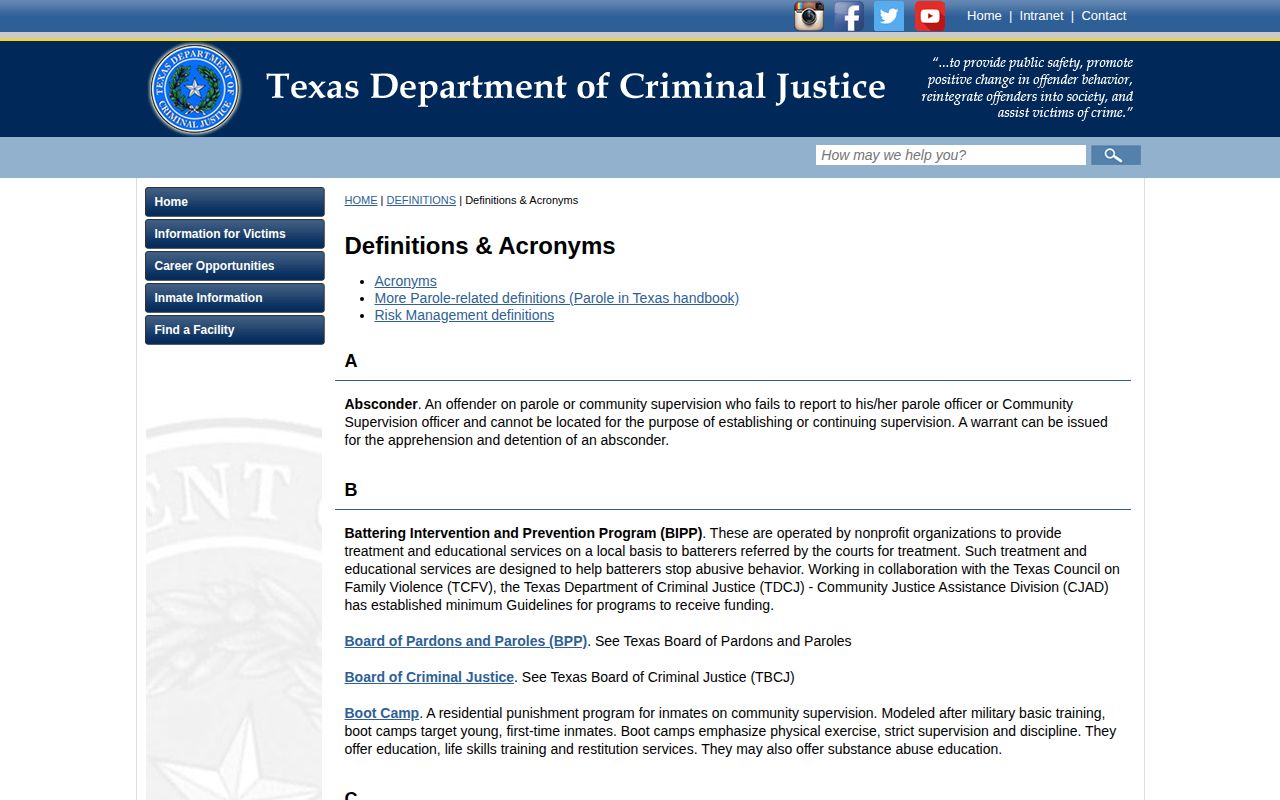
The TDCJ definitions page supplies the official projected-release and supervision terms illustrated here.
Carson County Release Dates and Good Time
Government Code §498.003 governs TDCJ good-conduct classifications and credits. It permits specific participation credits, including up to 15 days for each 30 days actually served for diligent participation in qualifying programs. Credits may be forfeited for misconduct. Good time can affect parole or mandatory-supervision eligibility where the applicable law allows it, but it is not a vested right to walk out on a chosen day.
Government Code §508.145 is offense and date specific. Under the general subsection (f) rule, actual time plus eligible good-conduct time generally must equal one-fourth of the sentence or 15 years, whichever is less, before parole eligibility. Listed serious offenses and weapon findings under subsection (d) generally require actual calendar time equal to one-half of the sentence or 30 years, whichever is less, subject to statutory minimums and special rules. Other categories have different periods.
County-Jail Good Time Is Not a Calculator
Code of Criminal Procedure Article 42.032 authorizes a sheriff to grant commutation not exceeding one day for each day actually served for good conduct, industry, and obedience when no misconduct charge is sustained. The word “may” matters. The authority is discretionary and should not be converted into a promise that every Carson County jail sentence is cut in half.
Credit for time already confined and the court's judgment also affect the calculation. No Carson-specific public good-time worksheet, release clock, or weekend and holiday adjustment policy was found. For a named county sentence, obtain the signed judgment and jail-credit order, then ask the sheriff for the official calculation. When the person leaves, request the actual release or transfer entry.
Note: Ask about weekend timing or the release desk by phone; the county publishes no rule that supports a firm claim.
Why Carson County Release Dates Change
A projected or scheduled date is a live records calculation. Some changes come from the sentence, while others come from custody outside the sentence itself. The correct follow-up depends on which agency made the change.
| Factor | Possible effect and confirmation route |
|---|---|
| Parole-panel action | A grant, denial, withdrawal, or later review can alter timing; confirm through BPP and TDCJ status. |
| Required program | An FI program vote can condition release on completion; check the official vote and later schedule. |
| Discipline or credit | Forfeited credit or a corrected classification can recalculate eligibility; request TDCJ records. |
| Detainer or hold | Another county, USMS, ICE, or other authority may receive custody; request destination from the releasing agency. |
| Court order or sentence correction | A judgment, credit, consecutive case, or later order can move the date; obtain the signed court record. |
| Release processing | A scheduled date or location may change before departure; confirm afterward with actual event records. |
Confirm an Actual Carson County Release
Texas IVSS-Counties can provide an alert for a supported county custody event, but its own guidance warns that data may be late, incomplete, or inaccurate. Current IVSS instructions also say a person no longer in custody may not appear. Use an alert as a prompt to verify, not as a certified release document. The Carson County VINE inmate check guide explains the migrated portal and registration choices.
For the county jail, pair the sheriff's release or transfer entry with the court record that gives the legal basis. For TDCJ, pair the scheduled information with later release, parole-supervision, or discharge records. BOP's locator can retain a release date, but that proves only exit from BOP custody. ICE status and federal court records likewise describe their own systems, not freedom from every hold.
A complete Carson County conclusion identifies the person through more than a name, states which custodian's date is being reported, labels it projected, scheduled, or actual, and records the receiving agency when the event was a transfer.
Public Record Search
Sponsored Results